

CREW MEMBER PROFILE |
||||||
Surname: |
BANNISTER |
First Name/s: |
Douglas Patrick |
 |
||
|
||||||
Service No/s: |
1866838 |
Service: |
RAFVR |
Branch: |
Wireless Operator |
|
|
||||||
Awards: |
1939-1945 Star, France & Germany Star, 1939-1945 War Medal |
|||||
SERVICE RECORDS |
|||
Date |
Event |
Aircraft Flown |
|
|---|---|---|---|
|
05 Feb 1943 |
Attended Nos. 4, 7, or 9 (tbc) Aviation Candidates’ Selection Board at No. 2 Recruit Centre, Cardington where he was recommended for training as Wireless Operator/Air Gunner. He then enlisted the same day as Aircraftman Second Class (AC2), mustering as Air Crew Hand (Wireless Operator/Air Gunner). |
||
|
06 Feb 1943 |
Transferred to the Reserve, pending call-up. |
||
|
26 Apr 1943 |
Called up at No. 1 Air Crew Reception Centre (ACRC), Lord’s Cricket Ground, St John’s Wood, London. |
||
|
15 May 1943 |
No. 19 Initial Training Wing (ITW), Bridgnorth, Shropshire. |
||
|
29 May 1943 |
No. 20 Initial Training Wing (ITW), Bridlington, Yorkshire. |
||
|
29 Jul 1943 |
No. 2 Radio School, Yatesbury, Wiltshire. |
Dominie, Proctor |
|
|
02 Mar 1944 |
Awarded Wireless Operator’s brevet, promoted to Sergeant, and remustered as Wireless Operator (Air) 1. |
||
|
27 Jun 1944 |
No. 1 (Observer) Advanced Flying Unit ((O) AFU), Wigtown, Wigtownshire. |
Anson |
|
|
01 Aug 1944 |
No. 28 Operational Training Unit (OTU), Wymeswold, Leicestershire; joins R R J Young crew. |
Wellington |
|
|
15 Oct 1944 |
Nos. 11/71 Base, Lindholme, Yorkshire; administrative Base for Nos. 1 & 7 Group heavy bomber conversions. |
||
|
16 Oct 1944 |
No. 1662 Heavy Conversion Unit (HCU), Blyton, Lincolnshire. |
Lancaster |
|
|
19 Dec 1944 |
Joined No. 576 Squadron, 'B' Flight at Fiskerton, Linconshire |
Lancaster |
|
|
14 Feb 1945 |
Dresden; lost in PD232 UL-O2, aged 20 |
Lancaster |
|
576 Squadron FLYING RECORDS |
|||||||
Date |
Aircraft |
Code |
Flight Details |
T/O |
Land |
Flt Time |
Crew |
|---|---|---|---|---|---|---|---|
|
07 Jan 1945 |
NG273 |
UL-Y2 |
MUNICH |
1840 |
0310 |
8h30 |
P1 Fg Off R.R.J. Young |
NOTES: |
Target: Industrial and transport areas. Load: 1x 4000lb 'cookie', 1320x 4lb incendiaries |
||||||
|
15 Jan 1945 |
ME801 |
UL-N2 |
ZEITZ - TROGLITZ |
1745 |
0135 |
7h50 |
P1 Fg Off R.R.J. Young |
NOTES: |
Target: Braunkohle-Benzin synthetic oil plant (low grade MT oil). Load: 1x 4000lb 'cookie', 12x 500lb bombs. Involved in combat with an unidentified aircraft - no claim made. |
||||||
|
22 Jan 1945 |
PD232 |
UL-O2 |
DUISBERG |
1645 |
2200 |
5h15 |
P1 Fg Off R.R.J. Young |
NOTES: |
Target: Steelwork coking ovens & rolling mills in the Hamborn area of the city and a benzol plant in Bruckhausen. Load: 1x 4000lb 'cookie', 16x 500lb bombs. |
||||||
|
01 Feb 1945 |
PD232 |
UL-O2 |
LUDWIGSHAFEN |
1600 |
2240 |
6h40 |
P1 Fg Off R.R.J. Young |
NOTES: |
Target: Marshalling yards, factories and enemy troop positions. Load: 1x 4000lb 'cookie', 1620x 4lb incendiaries |
||||||
|
02 Feb 1945 |
PD232 |
UL-O2 |
WIESBADEN |
2035 |
0310 |
6h35 |
P1 Fg Off R.R.J. Young |
NOTES: |
Target: Built-up area where large amounts of enemy troops were resting. Load: 1x 4000lb 'cookie', 1604x 4lb incendiaries |
||||||
|
07 Feb 1945 |
PD232 |
UL-O2 |
KLEVE |
1910 |
0015 |
5h05 |
P1 Fg Off A.H. Young |
NOTES: |
Target: Enemy strongpoints. Flown in support of the 1st Canadian Army and the 15th Scottish Division attacking the town. Load: 1x 4000lb ‘cookie’, 16 x 500lb bombs. |
||||||
|
07 Feb 1945 |
PD232 |
UL-O2 |
KLEVE |
1910 |
0015 |
5h05 |
P1 Fg Off R.R.J. Young |
NOTES: |
Target: Enemy strongpoints. Flown in support of the 1st Canadian Army and the 15th Scottish Division attacking the town. Load: 1x 4000lb ‘cookie’, 16 x 500lb bombs |
||||||
|
08 Feb 1945 |
PD232 |
UL-O2 |
POLITZ |
1905 |
0405 |
9h00 |
P1 Fg Off R.R.J. Young |
NOTES: |
Target: The IG Farben synthetic oil plant. AP: 5333.5N 01444.5E. Load: 1x 4000lb ‘cookie’, 10x 500lb bombs. |
||||||
|
13 Feb 1945 |
PD232 |
UL-O2 |
DRESDEN |
2125 |
FTR |
uk |
P1 Fg Off R.R.J. Young |
NOTES: |
Operation THUNDERCLAP. Target: built-up area. Load: 1x 4000lb ‘cookie’, 1180x 4lb incendiaries. At 2125 on the evening of 13 Feb 1945 Roland Young's Lancaster PD232 (UL-O2) took off from Fiskerton to attack the German city of Dresden as part of Operation THUNDERCLAP. The bomber Main Force route took them over the English Channel at Beachy Head to Boulogne then behind Allied lines to a position south of Strasburg where Main Force Lancasters turned North East towards Leipzig. At about 0100 a villager noted that he saw two aircraft collide over the lower Saxony village of Remlingen, 17 Km North of Wurzburg. Both aircraft were travelling in a north-easterly direction when they collided and en-route to the target. Records indicate that the two Lancasters were PD232 and PB183 (LQ-C) of 405 (Pathfinder) Sqn from Gransden Lodge. PB183 was probably a ʺbacker upʺ flying in the Main Force Bomber stream and carrying Target Indicators to reinforce the initial marking. As the aircraft impacted the ground, their bomb loads exploded making craters some 6m wide and scattering their wreckage over a distance of 1 km. The mid-air explosion caused part of one of the Lancasters to be blown 5km northwards where it came down near the village of Birkenfeld. The wreckage continued to burn for several hours and a Luftwaffe detachment arrived from Wurtzburg to guard the wreckage. The Burgermeister stated that he saw 5 engines in the wreckage, but no more. All Young’s crew perished and were buried initially, along with four of the 405 Sqn crew, in the village graveyard of Remlingen. The two Air Gunners, Ward and Webb were only 19 years old. The pilot of the 405 Sqn Lancaster had bailed out and was captured; his crew were carrying an eighth crew member, who also perished. The bodies of four of his crew were never recovered and are remembered on the Runnymede memorial. In Oct 1947 the bodies of the crew were identified in Remlingen village graveyard by Fg Off Bickerton leading a No.3 MREU search team tracing the whereabouts of downed aircrew. They were exhumed and reburied at the Commonwealth War Grave Cemetery at Dürnbach. |
||||||
PERSONAL INFORMATION |
|
Details |
|
|
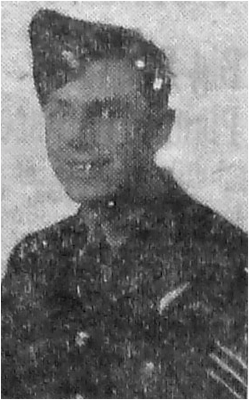
Douglas Patrick Bannister was born in Great Baddow, Chelmsford, Essex on January 27, 1925, the son of Bertie Bannister (1894-1973) and Gladys Maria Shorter (1903-1966). He was baptised at St. John’s Church, Moulsham, on March 1, 1925. His parents, Bertie and Gladys, lived at 51 Maldon Road, Great Baddow, and he grew up with his younger sister, June Sheila (later Ainger) 'Titch' (1930-1987). In September 1939 he was a school student, living with his parents and sister at 1a Bradford Street, Chelmsford, Essex. He received his education at Trinity Road School and Moulsham School in Chelmsford. An active and happy person known for his "genial disposition," he was fond of sports. He was a member of the Crompton Tennis and Cricket Clubs and played on the Air Training Corps (ATC) football team. He was also a member of the Chelmsford Boy's Brigade Band. In September 1939 he was a school student, living with his parents and sister at 1a Bradford Street, Chelmsford, Essex. Before enlisting in the RAF he was employed as an electrical engineer at Crompton Parkinson in Chelmsford. He died 14 February 1945 in air operations over Germany.
|
|
PHOTOS & DOCUMENTS |
|
Details |
|
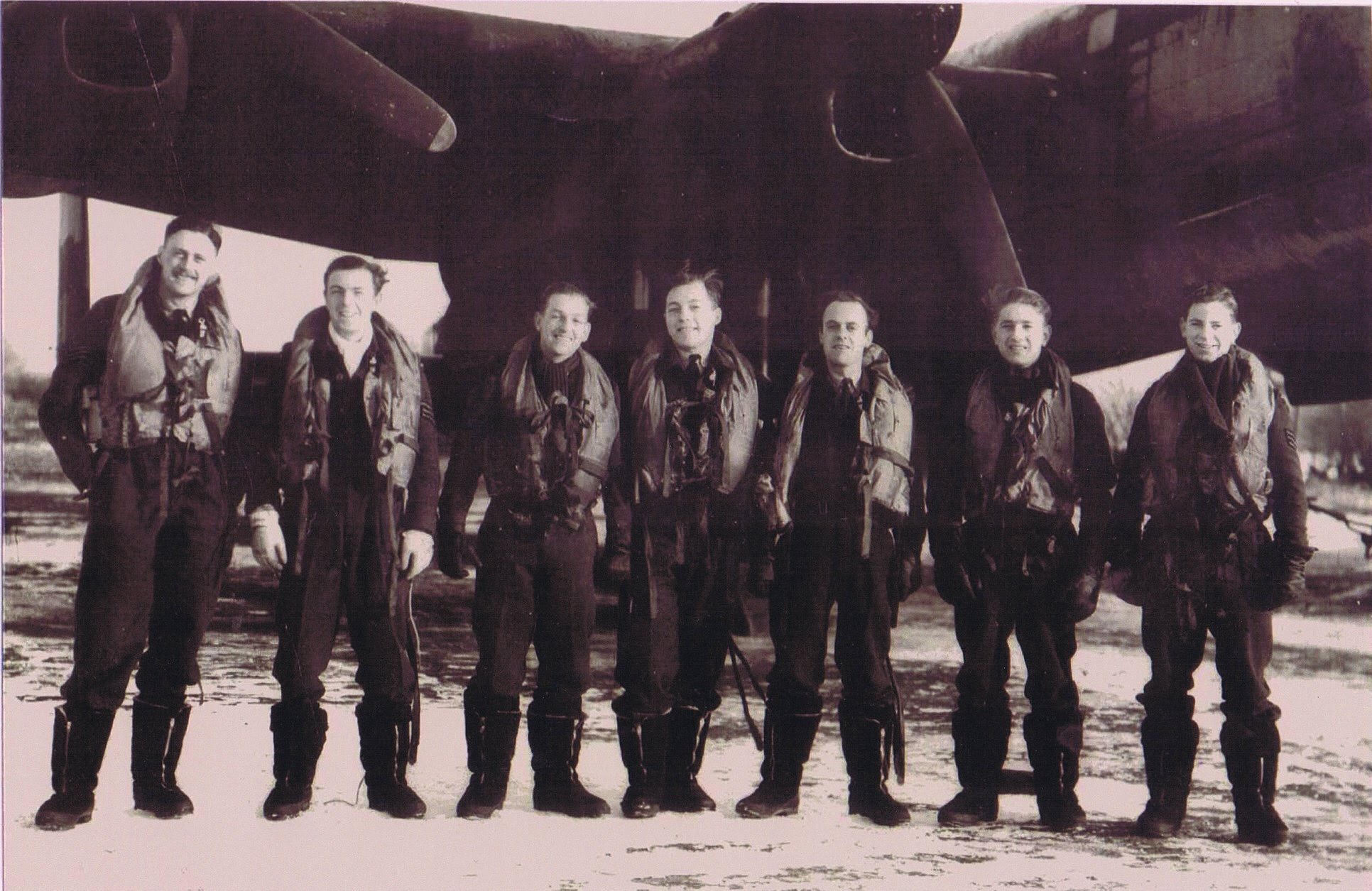
RR J Young and crew |
|
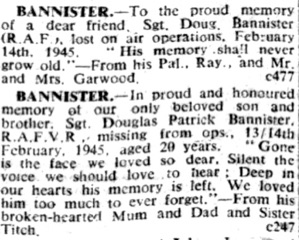
In memoriam |
|
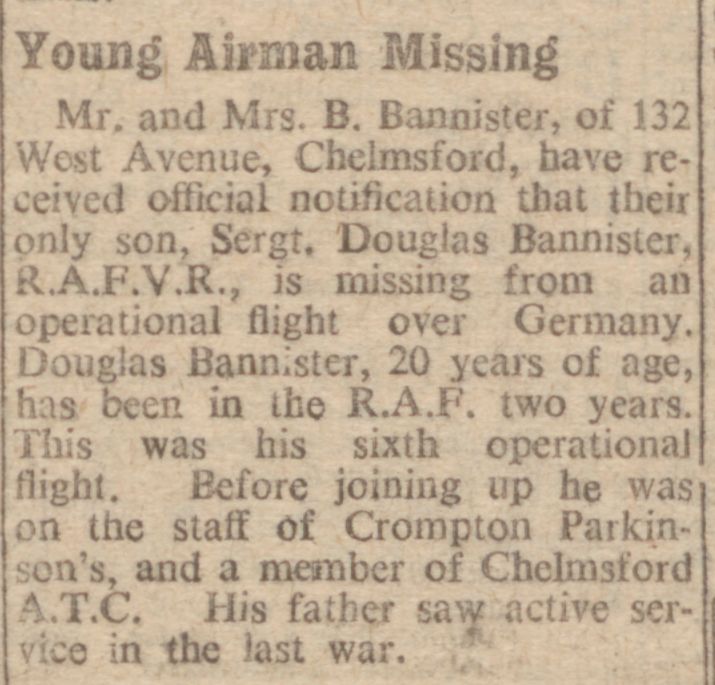
Newspaper notificationChelmsford Chronicle |
|
